
GTA San Andreas: What Did We Miss When We Played as Kids?
Return to San Andreas to understand CJ's journey, his relationships in Grove Street, and the culture behind missions remembered from childhood.
Follow LYFP Studio's Vietnamese GTA San Andreas story video, from CJ's return home to the ending.
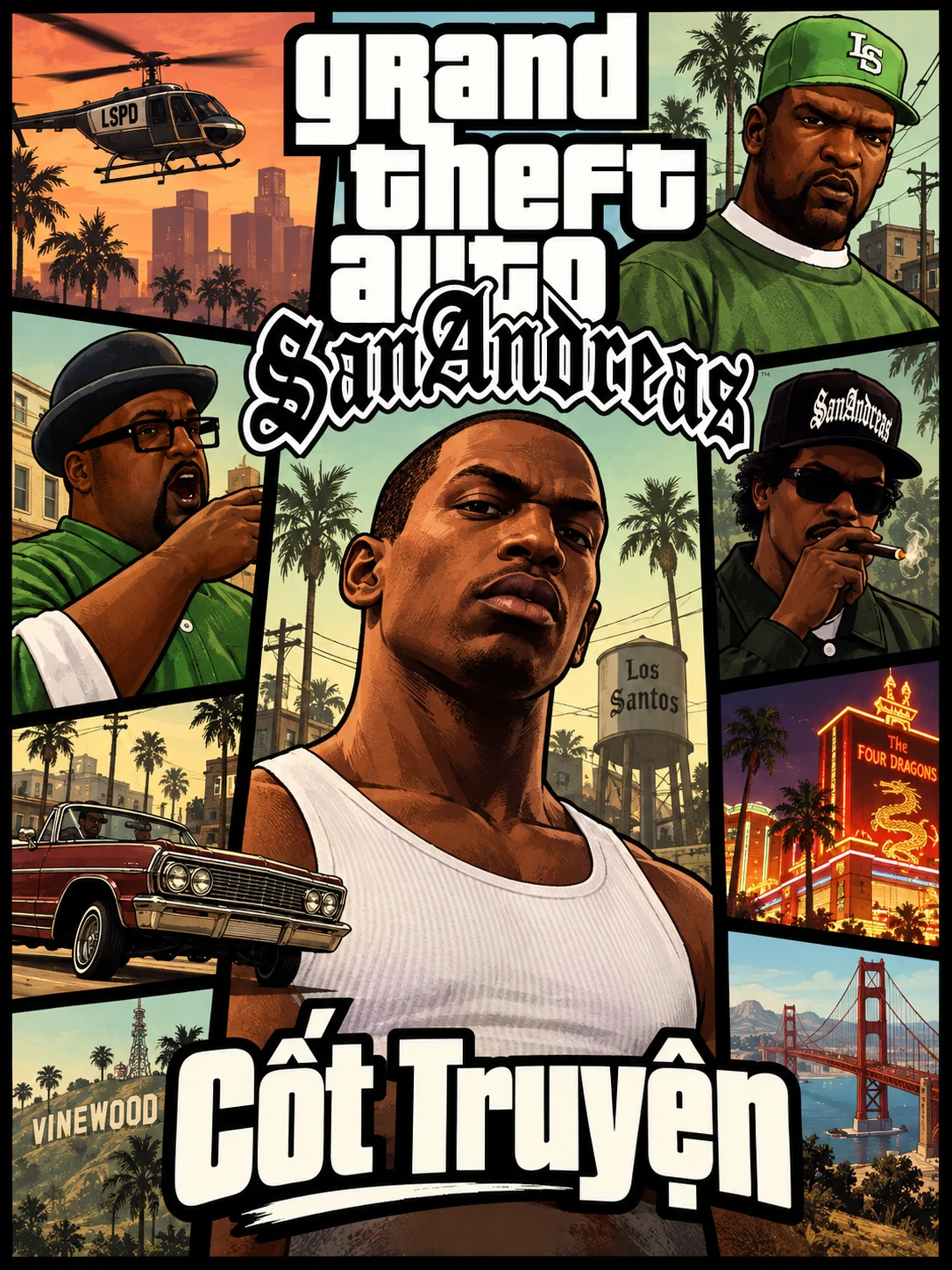
Watch within the article or open the YouTube app. The video is in Vietnamese.
From Grove Street to new cities. Illustration supplied by LYFP.
For many of us, playing GTA San Andreas as children meant entering cheats, driving around, and causing chaos across the map. CJ could cycle back to his neighborhood, work out, change his haircut, and travel through completely different cities. Those moments were enough to leave a lasting memory. Yet we may have missed the question running through the story: after going so far, why does CJ eventually return to Grove Street?
This article follows LYFP Studio's story video to revisit that journey. You do not need to know every mission name: follow whom CJ wants to protect, whom he can trust, and what each decision costs. Familiar scenes gain another layer for returning players, while newcomers get a way into San Andreas's story and world.
CJ comes home to bury his mother and becomes caught in the neighborhood's conflicts
The story takes place in 1992. Carl Johnson, usually called CJ, left Los Santos five years earlier to live in Liberty City. His mother Beverly's death brings him home. His brother Sweet and sister Kendl are still there, but the family has not moved past its earlier losses. Sweet still resents CJ's absence when his relatives needed him.
On the way home, CJ encounters Tenpenny, Pulaski, and Hernandez, officers in the C.R.A.S.H. unit. Tenpenny uses a murdered officer's case to threaten to frame CJ. A man who has just lost his mother must answer to someone who can turn a police file into a trap. Returning to save his family while being controlled by corrupt officers is also the premise in Rockstar's official introduction ↗.
From this point, several pressures lie behind each job CJ takes. He wants to regain Sweet's trust, help Grove Street hold together, and escape Tenpenny's control. A mission on the map may end quickly; the conflicts that pushed him into it keep traveling with him.
Grove Street: colors, reputation, and somewhere to belong
Grove Street is the neighborhood where CJ grew up and a base for the Grove Street Families. Sweet tries to hold the gang together as the Ballas gain influence, the Families' sets drift apart, and drugs weaken people in the neighborhood. Big Smoke and Ryder are old friends CJ joins again to ride around, collect weapons, and fight for territory.
Green identifies people on the same side, while respect has to be earned through actions. Working together helps CJ feel that he belongs again. However, relatives, friends, and gang associates do not always form the same circle. Wearing the same colors does not tell you how far someone will keep a promise.
Sweet opposes selling crack, but he and the people in Grove still use violence to contest territory. Understanding what he wants to protect does not make every gang action right. Two terms also need to stay distinct: crack appears in the story's drug trade, while C.R.A.S.H. is the name of Tenpenny's police unit.
Cesar and the lowrider: trust can begin beyond gang colors
Cesar Vialpando is Kendl's boyfriend and belongs to the Varrios Los Aztecas. Sweet is wary of Cesar's background and colors. CJ initially approaches him with that distance too, before a lowrider competition gives them another way to connect.
In Mexican American and Chicano communities, lowriding connects craftsmanship, style, pride, and community life. A customized car can express identity. The Smithsonian's exhibition ↗ explains this cultural context; owning a lowrider does not itself identify someone as a criminal.
Alongside CJ and Cesar's relationship, a remembered car-bouncing activity becomes the beginning of a friendship. CJ gets to see Cesar through something they both enjoy and through how he treats Kendl. Later, someone outside Grove's gang helps CJ see what people wearing his own colors have concealed.
OG Loc, Madd Dogg, and the cost of wanting fame
Jeffrey Cross calls himself OG Loc and wants to become a rapper. CJ helps his old friend by stealing Madd Dogg's lyrics and harming his manager. Players may remember the missions as a string of ridiculous situations. Within the story, they damage another person's work and life.
Through this relationship, rap connects to voice, reputation, and the question of who deserves recognition. OG Loc wants the image of success before developing the ability to match it. CJ helps him take a shortcut, then has to confront the consequences when he meets Madd Dogg again.
This matters to LYFP's reading of the story: CJ also makes mistakes and needs to repair the harm he causes. His growth can be seen in helping Madd Dogg recover and return to work, alongside victories that earn CJ more money or territory.
The Green Sabre: familiar people are no longer on the same side
Cesar takes CJ somewhere he can see Ryder, Big Smoke, and Tenpenny connected, together with the Green Sabre associated with the attack on the Johnson home. People who helped him rebuild Grove belong to another network. We do not need to add a conspiracy the game has not confirmed to understand why the discovery shakes him.
CJ still rushes to help Sweet in a gunfight, but Sweet is wounded and arrested. Tenpenny takes CJ into the countryside and continues forcing him to work. CJ loses his position in Grove, while his brother's life and future become further pressure keeping him in the game.
The turn matters because earlier rides and jobs with his friends built trust. CJ loses more than territory he has just reclaimed: he loses his old understanding of people close to him. To save Sweet and return, he now needs other foundations.
San Fierro: CJ learns to build instead of only reacting
The countryside takes CJ through chaotic situations with Catalina and The Truth. In San Fierro, his life starts to change rhythm: a garage, Kendl, Cesar, and skilled workers create the possibility of developing a business. CJ has something he can grow with others rather than always waiting for orders from whoever controls him.
Wu Zi Mu, commonly called Woozie, becomes another important connection. CJ cooperates with him and gradually attacks the Loco Syndicate drug network, which is connected to Big Smoke's power. These jobs create resources while tying life outside Los Santos to the unfinished conflict back home.
In LYFP's reading, the expanding map also expands CJ's understanding of whom he can trust. Kendl offers a practical direction, Cesar keeps his word, and Woozie provides opportunities to cooperate. The game's fictional gangs do not represent entire Chinese, Mexican, or Vietnamese communities in the real world.
With a casino, why are CJ's problems still unresolved?
Mike Toreno reappears with the ability to influence Sweet's imprisonment. He exchanges that help for dangerous jobs CJ must perform. Toreno has power beyond a trafficking network, but the game does not identify a specific agency that would justify casually calling him a CIA or FBI operative.
In Las Venturas, CJ and Woozie develop casino operations and take part in larger schemes. The lights, money, and organizational ability show how far CJ has come since cycling back to Grove. When he saves Madd Dogg and helps rebuild his career, a debt created by CJ's own actions also enters the journey.
However, money in Las Venturas does not automatically free Sweet or heal Grove Street's divisions. Toreno's help brings Sweet back and leaves CJ facing another question: what will he do for the people at home when he already has opportunities elsewhere?
Sweet and CJ: two understandings of a better life
CJ wants Sweet to see what he has become capable of achieving. Sweet looks at the weakened neighborhood and refuses to treat success elsewhere as the answer to Grove's problems. New possibilities are persuasive to someone who has traveled across the state. To someone who ties responsibility to the neighborhood, leaving can mean abandoning people again.
Both perspectives have limits. Sweet preserves a connection but struggles to see a path beyond Grove; CJ has abilities and relationships but cannot use them to evade unfinished responsibilities. Kendl helps us see that building a different life and caring about family can coexist.
The brothers work together again to help Grove recover. CJ also helps Cesar regain his position. In LYFP's reading, returning now means using abilities learned elsewhere to keep promises to people who matter, rather than pretending he never left.
The ending: breaking someone's control does not mean the city is healed
When the charges against Tenpenny are dismissed, Los Santos erupts in unrest. Placed beside history, the scene recalls anger in Los Angeles after the Rodney King verdict in 1992. This is an editorial comparison, not a claim that the game reproduces an actual event in full. PBS NewsHour ↗ provides context for the real event.
The dates must also remain separate: the LAPD published its report on the Rampart corruption scandal in 2000, not as the same event as Los Angeles in 1992. The LAPD announcement ↗ helps distinguish those contexts when discussing power and corruption; Tenpenny remains a fictional character.
CJ confronts Big Smoke and then joins Sweet in pursuing Tenpenny. Smoke dies in the confrontation; Tenpenny dies after a fire-truck crash. The Johnson family and people who accompanied CJ gather again, while Madd Dogg returns with an achievement in his career. The ending closes CJ's major conflicts while leaving the city with problems of its own.
Childhood missions start to mean something more
GTA San Andreas gives players time they can choose for themselves: getting a haircut, working out, driving without a mission, and finding an unfamiliar road. Those memories retain their value when revisiting the story. Understanding it gives places we passed through more connections to the people living there.
Grove Street connects to family and neighborhood reputation; the San Fierro garage to building with others; the Las Venturas casino to another level of success. Cities, countryside, and radio also carry GTA's satirical voice. The official manual ↗ presents different regional identities through a fictional guidebook.
For LYFP, what stays with us is how CJ relearns trust, responsibility, and what he calls home. He has a future beyond Grove and still has things to do in Grove. Perhaps that is what we did not yet understand as children: traveling gives us new abilities, while choosing whom to help with them gives returning its meaning.
When you think of San Andreas, do you remember a mission, one of CJ's friends, or somewhere you drove through without needing a reason?
About this article: A retelling and analysis based on LYFP Studio's GTA San Andreas script. Comments on family, trust, and growth are editorial readings, not statements of Rockstar's sole intended message. The article focuses on the main story and cultural layers discussed in the video rather than a guide to every mission.
Meet fellow gamers in Game Offline.
Share experiences, discover great games and meet people who share your interests.
Fragments of San Andreas memories
8 illustrations from the collection supplied by LYFP. Scroll sideways to explore and tap an image to enlarge it.
More worlds to explore together
Follow LYFP to revisit memorable stories, characters and moments in games.
Ready to return to San Andreas?
This article explores GTA San Andreas, originally released in 2004. The store below sells the classic PC Trilogy bundle; its 2005 date is not the original game’s release year, and it is not The Definitive Edition.
- Game
- Grand Theft Auto: San Andreas
- Original release
- 2004 · PS2
- Setting
- San Andreas · 1992
- Developer
- Rockstar North
- Publisher
- Rockstar Games
- Mode
- Single-player open-world action-adventure
References
Official sources alongside cultural and historical references. Connections about characters and the story’s meaning are LYFP’s editorial readings.
- 01Rockstar Store - San Andreas story introduction ↗
Official premise, developer and publisher. The store’s 2005 date belongs to the PC Trilogy bundle.
- 02Rockstar - San Andreas English manual ↗
The official manual presents regions and everyday life in the fictional world.
- 03Smithsonian - Corazón y vida: Lowriding Culture ↗
Lowriding culture, craftsmanship and community life.
- 04PBS NewsHour - Los Angeles and the 1992 Rodney King verdict ↗
Historical context for the editorial comparison with Los Angeles in 1992.
- 05LAPD - Board of Inquiry announcement, March 1, 2000 ↗
The 2000 announcement is separate from the 1992 Los Angeles events.
- 06Rockstar Games - San Andreas ↗
Rockstar’s game page, distinct from later editions and releases.
Article and analysis: LYFP Studio. Illustrations supplied by LYFP. Grand Theft Auto: San Andreas, its characters and game world belong to Rockstar Games / Take-Two and their respective owners.
GTA Vice City: You Played It Growing Up, but Do You Know the Story?
Return to Vice City and follow Tommy Vercetti as he builds a foothold.
Enter the story
GTA V Story: Three Dreams and the Cost of Starting Over
A different Los Santos, with three characters looking for another chance.
Enter the story