
GTA Vice City: You Played It Growing Up, but Do You Know the Story?
Return to Vice City to understand Tommy Vercetti's debt, his business relationships, and the 1980s culture behind a city of childhood memories.
Follow Tommy Vercetti's journey in LYFP Studio's Vietnamese story video.
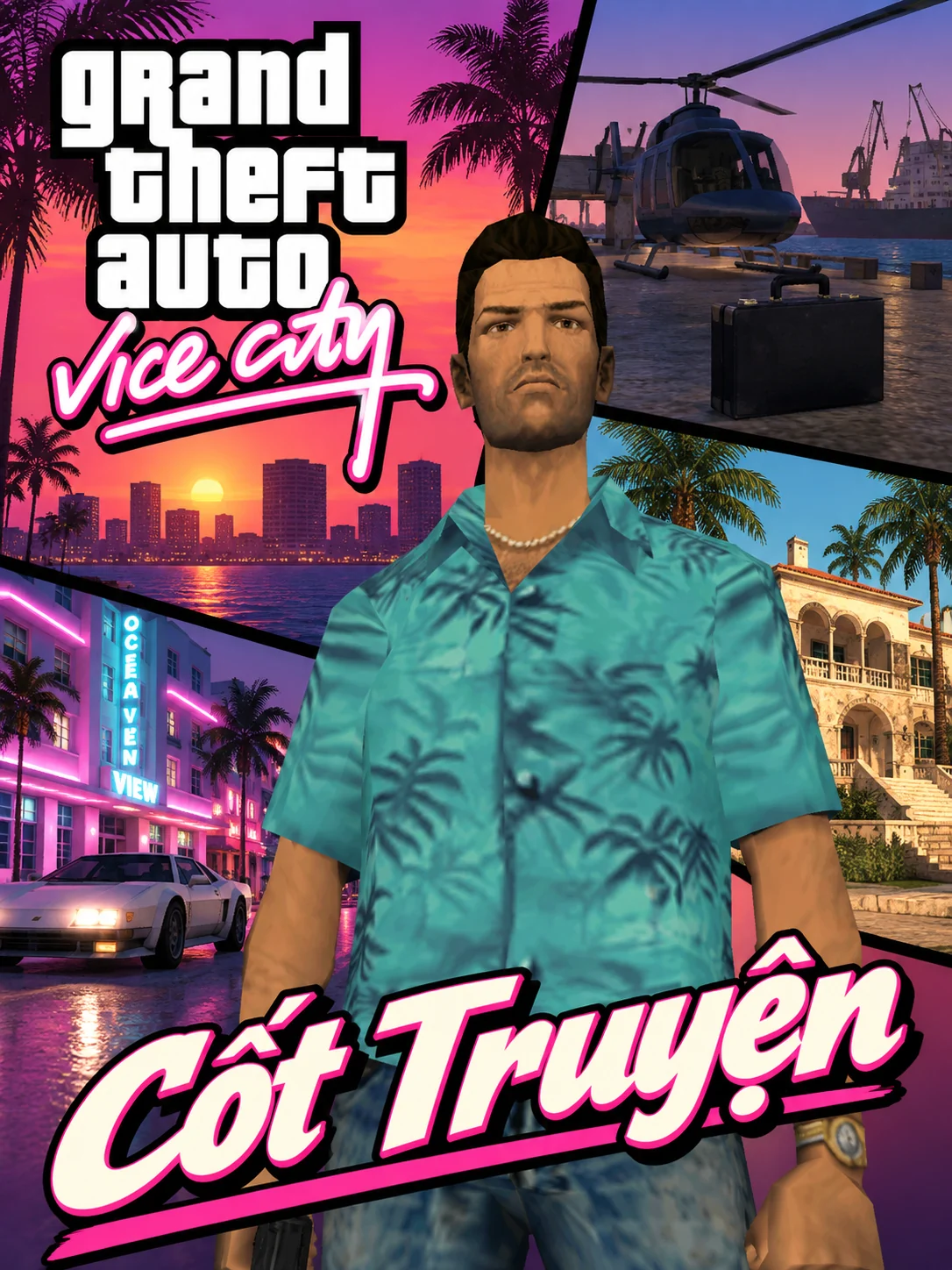
Watch within the article or open the YouTube app. The video is in Vietnamese.
Tommy in a city of memories. Illustration supplied by LYFP.
You may still remember summoning a tank, finding streets to escape the police, and Tommy's blue floral shirt. But put those chaotic adventures aside for a moment. What story remains? Why does a man just released from prison end up working for half the city before gradually taking control of his own life?
First released in 2002, GTA Vice City became part of many players' memories. This article returns to that city through LYFP Studio's story video, following Tommy Vercetti's debt, his business relationships, and the vibrant world surrounding them. Whether you grew up playing it or are discovering it now, one question offers a starting point: what is Tommy really trying to claim? Release information from Rockstar/Take-Two ↗.
A beautiful city with an ugly set of rules
The story takes place in 1986. Vice City is a fictional city inspired by Miami, with palm trees, pastel buildings, coastal roads, and nightclub neon. Its appearance makes life there seem like an invitation: get in a car, turn on the radio, and enjoy the city.
But in the world Tommy enters, expensive cars and large houses also display power. Who has money, who controls territory, and who can make others work for them? Behind the parties is a network he needs to understand before finding a place within it.
That cinematic atmosphere has roots in the game's development. In a retrospective interview, art director Aaron Garbut discussed the influence of Miami Vice and Carlito's Way, alongside Scarface mentioned in the question. Those influences can be seen in the fashion, scenery, and criminals who are both compelling and dangerous. Interview with Aaron Garbut ↗.
Tommy arrives for a job and immediately becomes a debtor
Tommy Vercetti worked for the Forelli crime family in Liberty City. Here, “family” means an organization, not Tommy's relatives. In 1971, Sonny Forelli sent him to kill a man in Harwood, but eleven gunmen were waiting. Tommy survived the ambush, earned the nickname the Harwood Butcher, and lost fifteen years to prison.
After his release, Sonny sends Tommy to Vice City to establish business interests. It sounds like a fresh start, but Sonny still supplies the money, gives the orders, and expects profits to flow back to the Forellis. The prison door has opened; the relationship of dependence remains.
Lawyer Ken Rosenberg arranges a deal with the Vance brothers. The meeting is ambushed: Victor Vance and Tommy's two companions are killed, while the money and drugs disappear. Tommy and Ken escape, and Victor's younger brother Lance also survives. To Sonny, his subordinate's near-death experience changes nothing about the obligation to repay him. Tommy must find whoever was responsible before his former boss runs out of patience.
Finding a culprit means learning to read the whole city
Ken introduces Tommy to a network of influential people. Colonel Juan García Cortez helped arrange the failed deal; Avery Carrington makes money in property; Kent Paul knows people and rumors in the music business. Each offers a path forward, but those leads usually come with a problem Tommy must solve.
Kent Paul points Tommy toward Leo Teal. The encounter in the alley ends with Leo's death and Lance's arrival. Tommy wants his money back; Lance wants revenge for Victor. Their goals point in the same direction, but their pressures differ. Leo's phone provides another lead connected to Ricardo Diaz, a powerful boss with money, men, and territory.
Tommy cannot simply walk into the mansion and demand everything back. He works for Diaz to gain access to him. The missions therefore operate on two levels: openly, Tommy solves his employer's problems; underneath, he learns how that employer's network works. Payment is the immediate benefit. Access brings him closer to his goal.
From guarding the gate to breaking through it
Lance refuses to wait. He attacks Diaz on his own, is captured, and forces Tommy to come to his rescue. Tommy takes him from the scrapyard to the hospital, but saving him also makes it difficult to keep pretending they are on Diaz's side. They must act before his organization crushes them.
Tommy and Lance assault the mansion, kill Diaz, and take it over. The goal has grown beyond recovering stolen money: Tommy now has a base, an organization, and the ability to build his own power. Yet Sonny keeps calling. Tommy sees himself as an owner; Sonny sees a subordinate withholding his share. Taking the house does not settle who has the right to give orders.
Why do the businesses matter to the ending?
The properties change both the way the game plays and Tommy's ambitions. The boatyard, Kaufman Cabs, Malibu, and other businesses turn map locations into sources of income. A man who once only accepted jobs learns to own things that generate them. Even the Cherry Poppers ice cream business has another side, with its van used to sell drugs.
Activities that were fun when playing as a child now reveal their purpose within the story. Smashing shop windows to force owners to pay protection money is not random rebellion. It is how Tommy imposes control. He is not making the city fairer; he is claiming a larger stake in how it makes money.
The print works connects business to both memory and the final confrontation. Earnest Kelly reminds Tommy of his father's work in printing, offering a rare moment of warmth among cold business relationships. But the business can also produce counterfeit money. When Forelli collectors arrive and beat Earnest, Sonny's pressure reaches a place Tommy has built up. The original debt has become a dispute over an entire empire.
Lance betrays him, while Sonny claims ownership of a person
Tommy prepares counterfeit money to deal with Sonny. During the meeting at the mansion, however, Lance changes sides and exposes the plan. The man who fought alongside Tommy and owed him his life now stands beside the person who wants to take everything back.
Seen through their partnership, that betrayal raises an uncomfortable question: is winning together enough for two people to accept their respective positions? In LYFP's reading, Tommy and Lance's alliance can be understood through the gap between building power together and deciding who actually holds it. This is editorial interpretation, not a claim to know every motive inside Lance's head.
Sonny brings the story back to Harwood. Tommy confronts him about the eleven gunmen waiting there and the fifteen years he lost. Sonny still treats Tommy's life as something he can determine. The conflict now goes beyond the money in two briefcases: it concerns a person's ability to live outside someone else's orders.
Tommy kills Lance on the roof and defeats Sonny in the main hall. Ken returns, still anxious and talking constantly. The game closes the victory with the pair's familiar humor rather than a ceremony declaring Tommy a hero. He has gained control, but the road there remains one of violence, coercion, and dirty business.
Vice City's culture is also in what makes us laugh
Diaz can terrify people yet lose his temper over a television. Love Fist draws Tommy into the world of a chaotic rock band. Ken helps handle business while almost always giving tense situations an extra comic edge. Characters can be dangerous, useful, and ridiculous at once; that is part of Vice City's tone.
The city also contains different communities and factions. However, its fictional Cuban and Haitian gangs cannot serve as representative portraits of real people. Revisiting those missions means recognizing exaggeration and stereotypes in their presentation, rather than treating every detail as authentic culture. Understanding a game also includes noticing the limits of how it sees the world.
The city of our childhood is still there, with more meaning
What makes Vice City memorable goes beyond whom Tommy defeats. It also lies in the time players choose for themselves: driving without following a mission, trying a road, or revisiting a corner simply because they enjoy its atmosphere. Those memories do not have to wait for the story to end.
But understanding Tommy's journey gives the familiar map more layers. The mansion is a place where ownership changes. The print works evokes his father and creates a way to confront Sonny. A nightclub can provide information, help organize a robbery, or become a business. Locations stop being merely places to pass through.
In LYFP Studio's video, Tommy moves from a man who must repay Sonny's debt to one who gives his own orders. That reading does not turn him into a good man. It helps us understand what he pursues, what his choices cost, and why a city we once used as a playground remains worth returning to years later.
When you think of Vice City, do you remember a mission, something on the radio, or a place you drove through without needing a reason?
About this article: A retelling and analysis based on LYFP Studio's GTA Vice City video script. Comments on power, relationships, and memory are editorial readings, not statements of the developers' sole intended message. The article focuses on Vice City's story rather than instructions for completing every mission.
Meet fellow gamers in Game Offline.
Share experiences, discover great games and meet people who share your interests.
The colours of a city of memories
21 illustrations from the collection supplied by LYFP. Scroll sideways to explore and tap an image to enlarge it.
More worlds to explore together
Follow LYFP to revisit memorable stories, characters and moments in games.
Ready to return to Vice City?
This article explores GTA Vice City, originally released in 2002. The store link below sells The Definitive Edition trilogy, not the original 2002 edition.
- Game
- Grand Theft Auto: Vice City
- Original release
- 10/2002 · PS2
- Setting
- Vice City · 1986
- Developer
- Rockstar North
- Publisher
- Rockstar Games
- Mode
- Single-player open-world action-adventure
References
Publisher sources and a direct developer interview, distinct from LYFP’s editorial interpretation.
- 01Rockstar/Take-Two - Vice City's anniversary announcement ↗
Publisher announcement: Vice City originally launched on PS2 in October 2002.
- 02Aaron Garbut looks back at GTA Vice City ↗
A direct interview with art director Aaron Garbut about cinematic influences and development.
- 03Rockstar Store - Vice City's story introduction ↗
The official introduction to Tommy and Vice City. The store page sells the 2021 Definitive Edition trilogy.
Article and analysis: LYFP Studio. Illustrations supplied by LYFP. Grand Theft Auto: Vice City, its characters and game world belong to Rockstar Games / Take-Two and their respective owners.
GTA V Story: Three Dreams and the Cost of Starting Over
From Vice City to Los Santos, meet three people looking for another chance.
Enter the story
GTA IV Story: Niko Bellic and the Price of the American Dream
Return to Liberty City with Niko Bellic and an American dream burdened by debt.
Enter the story