The mystery of Temple RunWhat if you never left the temple?
You have run for thousands of metres. But what if the runner’s body is still inside the temple, and the path ahead exists only in his mind?
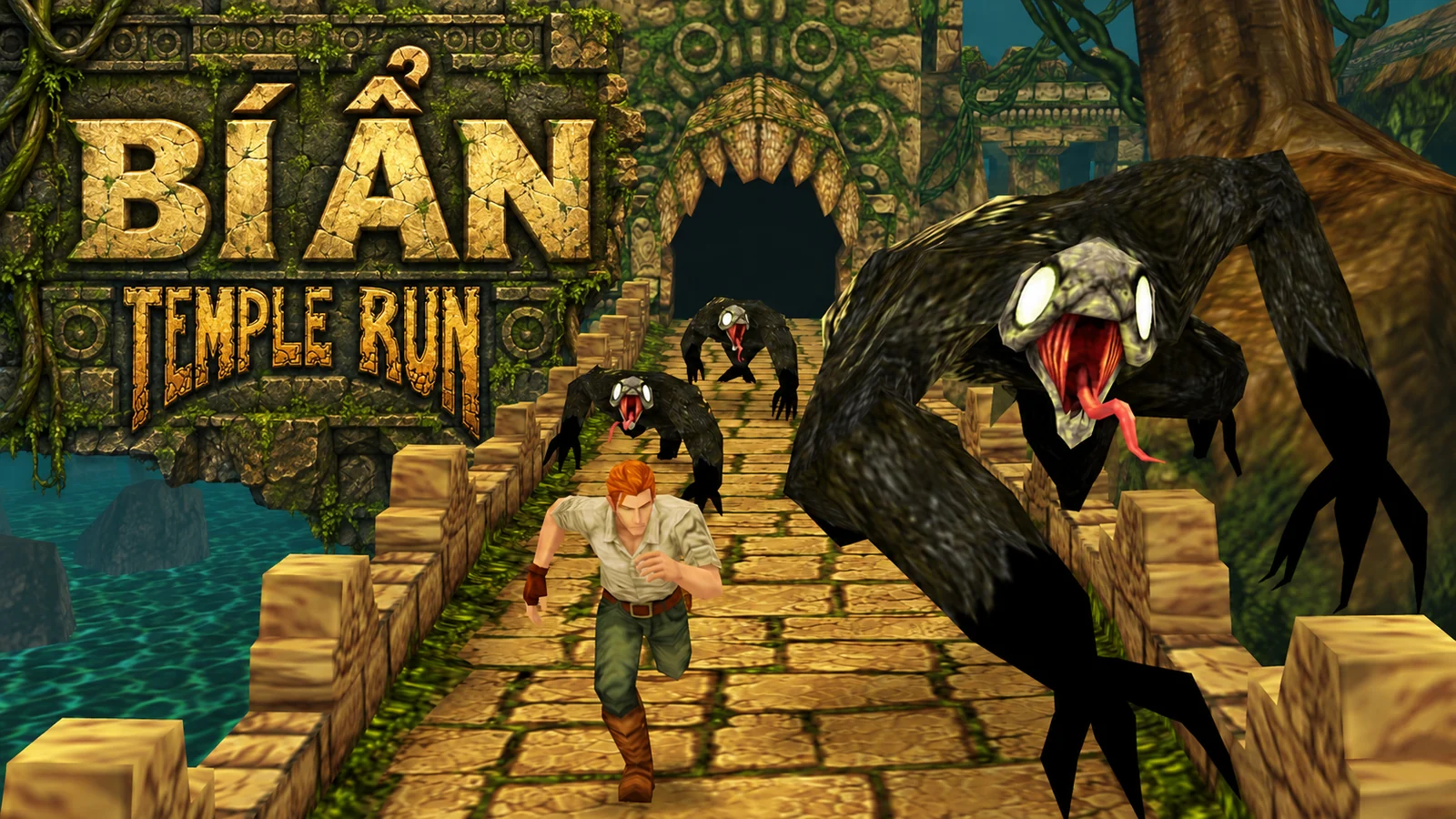
Watch within the article or open the YouTube app. The video is in Vietnamese.
How far did you get in Temple Run? A few thousand metres? A record that once seemed impossible to beat?
Now keep everything on screen exactly as it is: the bridge, the coins, the footsteps and the monkeys behind you. Change only one thing: throughout that entire run, the runner’s body has never left the temple.
Then who is running? And why are they not allowed to stop?
The promise of one more run
Some games are remembered through our hands. Temple Run meant tilting the phone to collect coins, swiping over a tree root, sliding under an obstacle and turning before the path ran out. Borrowing a phone could mean losing track of time. Someone beside you called out a turn; your finger slipped. You lost, felt the disappointment, and asked for another try.
The rules were immediately clear. Getting everything right as the pace increased was harder. Each failed run left one specific mistake to fix: jump earlier there, stop chasing coins here. You did not need to learn the whole game again. You only needed to correct a moment.
That gave the restart button its appeal. It promised that next time would be better. One more attempt, and you would pass that obstacle. One more attempt, and the number on screen would rise.
For the player, that was a simple pleasure. From the runner’s perspective, the promise might mean something else. We have another opportunity. He has to return to the same path.
An idol and a pursuit
Imangi’s official introduction establishes a compact premise: you steal a cursed idol from the temple and run from the Demon Monkeys pursuing you. Turning, jumping, sliding, collecting coins, buying power-ups and unlocking characters form the game’s familiar loop. That is the starting point supported by an official source. [O1]
What follows belongs to the imagination: why does the path keep extending, why do the monkeys return, and how far must you run before you are truly free? This article starts in that gap. These theories do not speak for the developers. They try to change the meaning of a run we already know.
Close enough for fear, far enough for hope
In Game Theory: Temple Run, panpanadero reads the endless run as a punishment connected to the idol’s curse. A comment by squidmd develops the idea of pursuit and prolonged fear. That gives us another way to imagine the distance between the runner and the monkeys. [T1]
You cross a bridge and turn another corner. The forest remains dark, the stones moss-covered, and the path open. You have travelled further, but nothing proves that you are nearer an exit. Even when the monkeys disappear from view, a single stumble brings them close again.
If this is a punishment, the distance is almost perfect: close enough to frighten you, far enough to preserve hope. Catching you immediately would end things too soon. Letting you glimpse a possible escape, and compelling you to chase it, keeps the pursuit alive.
Every obstacle gives you something to do immediately. Jump. Slide. Turn. Survive another few seconds. Small decisions fill your attention until there is no space for the larger question: where am I actually going?
You may choose left or right, a jump or a slide. One choice is never offered: standing still. In this imagined reading, freedom exists within individual reactions. The direction of the entire journey has already been decided. Keep running.
A still body. A chase that continues.
Pull back from the moving screen. Inside a room in the temple, someone lies motionless on the stone floor, still gripping the idol. Nobody has just rushed through the doorway. Perhaps the footsteps exist only inside his head.
That is the direction of masbate’s hallucination theory on r/FanTheories: the runner may be trapped in a mental world while his body remains inside the temple. The original post imagines a hallucinogen protecting the treasure. It is the author’s speculation, and commenters challenged its lack of evidence. [T5]
LYFP connects that imagined situation with the idea of punishment. No enclosing wall is needed if the desire to escape creates the space ahead. Fear a chasm, and a bridge appears. Fear capture, and you hear breathing behind you. Believe you are free, and another corner opens.
Such a maze is not simply waiting for someone to enter. Each fear renews it. The more desperately he searches for survival, the more reasons his mind has to invent another bridge, cliff and forest. What looks like a way out is what keeps the run going.
The unsettling part is the contrast: within the experience, he has crossed countless obstacles; outside it, his body has not taken a step. The effort feels real to the person enduring it, yet the distance to the temple door never changes.
Starting again does not mean forgetting
Then the runner misses a step. Wind rushes past, stone approaches, the screen goes dark. Moments later he is back at the temple entrance, clothes intact, legs ready to run, monkeys calling again. For us, a new game has begun.
Add one detail developed by LYFP: the body is restored, but the sensation of the previous death remains. Starting again no longer erases the experience. It merely returns him to the right place to endure it once more.
You see a bridge and remember falling there. You flinch before reaching the fire. A familiar stretch of path may contain failures that nobody else remembers. The player sees another chance; the person inside must cross the place where he just died.
Even time becomes uncertain. If the imagined trance does not follow the clock outside, how long would our few minutes with a phone feel to him? The story offers no number. The uncertainty alone makes the invitation to restart feel heavier.
A gift that makes the prison longer
How does he still have the strength? TheLastMisanthropist’s theory proposes that the idol grants its holder extraordinary endurance and powers. This interprets gameplay mechanics; it is not information confirmed by Imangi. [T3]
Within our imagined trance, the gift becomes troubling. The idol gives you strength to run, but running is not necessarily escaping. Each time exhaustion seems close, you can continue. What rescues you from an ending might also prolong the punishment.
In Why the temple is infinite, ScandLynx imagines that the idol’s holder can create the path ahead. LYFP borrows that idea for the next connection: you picture an escape, and the idol builds a road; you dodge left, and the maze gains another branch. [T2]
Every life-saving reaction lengthens the world that confines you. Behind you, the old road dissolves. Repeated turns cannot return you to a place that disappeared when you stopped imagining it. Running faster only lets you build more of the prison.
A fear that did not begin with you
Here LYFP adds another fictional connection. What if the idol never lets those roads disappear entirely? It could retain pieces as memories, ready to rebuild them. Not just your paths, but ones shaped by previous runners.
You reach a bridge you have never seen, yet your body hesitates. The feeling could be a memory that is not yours. Perhaps someone else fell there. The path survives as fear, then passes to the next person holding the idol.
This is not a secret discovered in game files. It is an extension of the story we are imagining. But it changes the bridge again: what lies ahead might be more than an obstacle. It could be the trace of runs nobody witnessed.
The keeper of the loop is holding a phone
A community post once compared Temple Run to life: continually moving forward and accumulating things can distract us from asking why we are running. That is a metaphor for reflection, not an explanation of the game’s story. [T4]
In LYFP’s story, bring the question closer: to the hand holding the phone. We see a record; the runner experiences every metre. We are pleased to survive longer. If he remembers every death, would living longer mean the same thing to him?
The final score can be read another way: how much longer the person inside had to endure. Meanwhile, we remember the corner where our finger slipped. Next time we can fix it. Next time will be better. The reason to continue is already waiting on our side of the screen.
There is no need to turn a happy memory into an accusation against the player. The unease lies in one action holding two meanings: for the person tapping, another attempt; for the person in the trance, another summons back.
The quiet before the footsteps
In this imagined world, the body never left the temple. The mind keeps building escape routes. The idol sustains the runner, and fear makes him continue. Then the game ends. For the first time throughout the chase, the footsteps stop.
We used to fear running out of lives. For someone trapped in this trance, that could be the only rest available. But a finger touches the screen again. Inside the temple, the hand gripping the idol tightens.
Footsteps begin.
Just one more run.
Meet fellow gamers in Game Offline.
Share experiences, discover great games and meet people who share your interests.
Other views of the nightmare
A selection of illustrations chosen by LYFP for this story. Swipe to explore and tap an image to enlarge it. These are AI illustrations, not official in-game images.
More worlds to explore together
If you enjoy these perspectives, join Phi on YouTube and Facebook for gameplay, stories and conversations about games.
Ready to revisit Temple Run?
The original Temple Run by Imangi Studios. Choose the official store for your device.
References
Official information establishes the premise. Community posts supply the theories. The connections involving memories, previous runners and the ending are LYFP’s own development.
- Official informationImangi Studios · Temple Run ↗
- Community theorypanpanadero · Game Theory: Temple Run ↗
- Community theorymasbate · It’s a bad trip ↗
- Community theoryTheLastMisanthropist · The idol grants superpowers ↗
- Community theoryScandLynx · Why the temple is infinite ↗
- Community metaphorr/awakened · Life is a game and it is like Temple Run ↗
Stay for another story?
From a run with no finish line to journeys where we need each other.