
God of War 3After defeating Zeus, what does Kratos have left?
Kratos can drag gods from their thrones. But when Olympus falls, who can bring back the people he has lost? A return to God of War III, from the thrill of victory to the emptiness that follows.
Revenge pursued to its end. See how Kratos’s victories lead to the empty box, Pandora and his final choice before Athena.
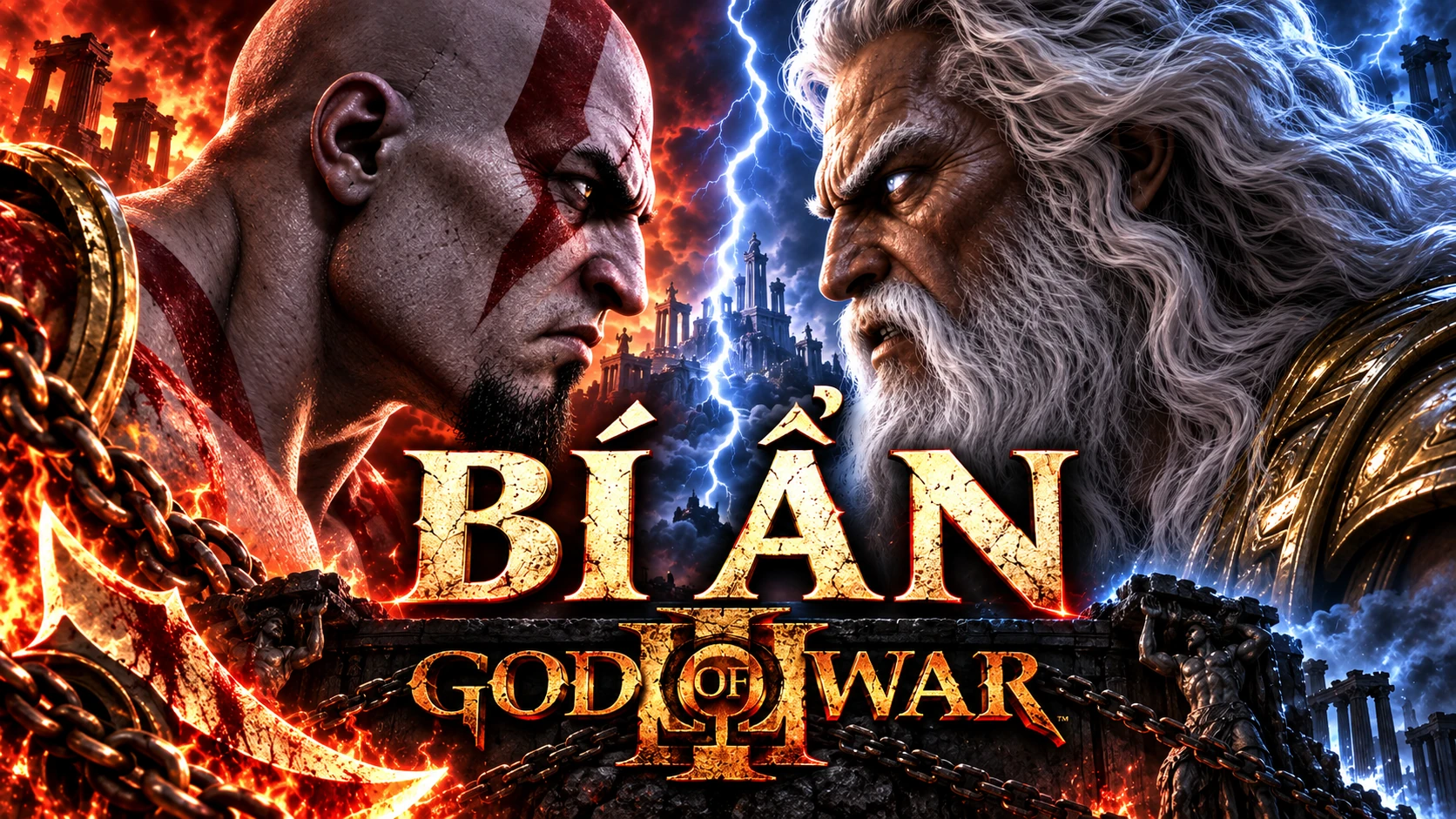
Watch within the article or open the YouTube app. The video is in Vietnamese.
Father and son stand on opposite sides of an Olympus about to collapse. AI illustration · LYFP Studio.
Zeus must die. For Kratos, that is enough to begin a war. For the player, it establishes a clear destination: cross Olympus, defeat everyone in the way, and reach the father who betrayed him.
God of War III makes that destination compelling almost at once. Titans climb the mountain. The sea rises. Chained blades blaze through a world hundreds of times larger than Kratos. The game knows how to make even a small step forward feel like a triumph.
Then the gods fall, one by one. Kratos grows stronger, but the world around him begins to die. Another question quietly follows his revenge: if he reaches Zeus, what will he have left to bring home?
A battlefield that moves beneath you
The opening assault picks up where God of War II ended. Kratos and the Titans attack Olympus, and Gaia becomes his route to the summit. The ground beneath the player is flesh, stone and vegetation on the body of a living creature. Every time Gaia shifts, the battlefield changes its angle.
Climbing, clinging and combat are tied to the same predicament. To strike back at Poseidon, Kratos must first keep his footing. At times the camera pulls away until his body almost disappears against the Titan; then it suddenly moves close, bringing danger back within arm’s reach. Scale becomes something felt through the need to survive it.
Later, the encounter with Cronos takes this idea further. A hand can become a wall; a movement can change the entire route. The game turns an opponent’s body into terrain to read and cross. This is something distinctive about God of War III: even its colossal battles are told through Kratos’s tiny footholds.
The moment the camera changes sides
Stripped of the power surrounding him, Poseidon lies before Kratos. The god warns him what will happen if Olympus is destroyed. But Kratos has gone too far to listen. Then the camera shifts into Poseidon’s viewpoint, placing the player on the receiving end of that rage.
The finishing inputs still bring the battle to its conclusion. Only our position within the image has changed. The face rushing towards the screen is now Kratos. The dominance the game just gave us takes on a more disturbing shape: seen through the victim’s eyes, the hero we control looks like a catastrophe.
Poseidon dies, and the sea floods the land. The game links a personal victory to consequences far beyond the battlefield. The player is allowed to move on; the mortals below have no choice. From the very first god, God of War III places exhilaration beside unease.
A son carrying his father’s fear
At the summit of Olympus, a son approaches his father with a blade in his hand. Zeus has a throne to protect; Kratos has a grievance to settle. In the game’s world, power and blood ties are tightly intertwined. Fear of being overthrown by a child turns the home of the gods into a place where family members must guard against one another.
The story also gives that fear a concrete form. When Kratos opened the box years earlier to defeat Ares, its evils escaped and took hold of the gods; Fear found Zeus. This helps explain the king’s corruption within the story, but it does not make his wrongdoing disappear.
Gaia has a war of her own. When Zeus knocks them both from the summit, she abandons Kratos as he struggles to hold on. His ally only needed him while he was useful. Promises keep passing the warrior from one powerful hand to another.
Olympus, the underworld, Titans and the sacred flame give the story its Greek setting. Yet this is God of War rewriting mythology to construct its own tragedy. When we consider Zeus’s or Pandora’s motives, we are following the rules of the game’s world, rather than treating its scenes as an original account of ancient myth.
Every weapon is a piece taken from the world
Falling into the River Styx, Kratos is drained of his strength. Athena appears in spirit form, gives him the Blades of Exile and points him towards the Flame of Olympus. After the powerful opening, the player must rebuild his ability to fight. The character’s loss becomes something felt through what his hands can still do.
The journey to regain strength is also a journey of taking. Hades’s claws become a new weapon. Helios’s severed head lights the darkness and reveals hidden paths. Hermes’s boots open routes that require speed. Hercules’s Nemean Cestus adds heavy blows and the ability to break certain obstacles. Each reward changes both combat and exploration.
On the other side of these rewards, the world loses what once sustained it. Helios falls, and darkness covers the sky. Hermes’s death brings disease. When Hera dies, the vegetation around her withers. The game repeatedly places two movements side by side: Kratos gains power as life around him diminishes.
This is where gameplay sharpens the story. The reward is immediate: a new tool and a newly opened door. The cost is often farther away, in a darkened sky or a devastated landscape. That distance can encourage a player to keep advancing before pausing to consider what has just been traded for victory.
Two fathers, one child
Among those trying to protect their thrones, Hephaestus wants to protect his child. Pandora was born from the Flame of Olympus and can extinguish it, opening the way to the box inside. But to the smith god she has become a daughter. What others call a key is a life he wants to shelter.
His promise to forge a weapon for Kratos therefore becomes a trap. Hephaestus sends him to retrieve the Omphalos Stone from Cronos, hoping the warrior will never return. When the plan fails, he risks an attack and pays with his life. Even at the end, what he pleads for is Pandora’s safety.
Kratos knows what it means to lose a child. Yet the path he follows leads directly to the child another father has just died to protect. That gives Pandora’s rescue another weight: the man who saves her is also taking her to the place Hephaestus feared most.
When Pandora trusts and embraces Kratos, the story slows down. After hands used to pull, crush and seize, the game shows us a hand beginning to offer support. Their relationship reaches the humanity buried beneath his anger. From this point, winning a fight may no longer be the most important thing in a scene.
The hand that could not hold on to Pandora
Before the Flame of Olympus, Kratos wants to find another way. Pandora understands that she must enter the fire to open the path to the box. Then Zeus appears, dragging them back into the conflict between father and son. During the fight, Pandora runs towards the flame; Kratos catches her hand.
It is a small image in a game full of enormous bodies. Kratos has clung to Titans, resisted Hades’s pull and subdued countless enemies. Now all he needs to do is hold on to one person. But Zeus invokes his dead daughter, and the old rage takes hold again.
Kratos lets go to charge at Zeus. Pandora enters the fire. The scene hurts because the game has shown us a moment that might have been held a little longer: she was still at the other end of his hand. Strength lets Kratos overcome almost every obstacle, but it cannot help him control his reaction at the moment it matters most.
The empty box and what was there all along
The flame goes out. Kratos opens the box. It is empty. After a journey that repeatedly teaches the player to expect a reward for overcoming a challenge, God of War III presents a void precisely where its greatest promise was placed.
Pandora is dead, and the power Kratos sought is not there. The meaning of her sacrifice only becomes clear at the end. After the battle inside Gaia, Zeus’s spirit still drags Kratos into darkness, where memories of his wife, daughter and Pandora return. Those losses were never healed by victory.
Pandora’s voice in his memory leads him to Hope. According to Athena’s explanation at the end of the game, she placed that power in the box to counter its evils. When Kratos opened it in the first game, the evils escaped while Hope entered him, then became buried beneath fear and guilt.
Pandora helps Kratos rediscover what was already within him. This is a real power in the story; it also allows the ending to be read as the moment he begins confronting the part of his life he has always tried to bury. Pandora’s voice continues to matter after the flame has gone out.
One more power waiting to be claimed
Zeus finally falls beneath Kratos’s blows. The inputs build towards a finishing sequence in which red gradually fills the screen. The destination of the entire revenge quest is here. But when the rage subsides, no family has returned to welcome him.
Athena appears and demands Hope back. The one who guided Kratos now wants to possess the power that remains. After the gods and the Titans, someone once again stands before him to decide who that power should belong to.
Kratos turns the Blade of Olympus on himself. The act releases Hope to humanity instead of handing it to Athena. At the end of a game where rewards usually mean taking power into his hands, he chooses to let power leave them.
One can read this as the moment Kratos finally breaks from being someone else’s instrument. Yet Hope does not immediately rebuild the flooded cities or undo Pandora’s death. Humanity receives a chance amid consequences that still exist. The distance between opportunity and redemption keeps the ending from feeling comforting.
A trail of blood instead of closure
In the final image, Kratos’s body is no longer there. The sword remains, and a trail of blood leads towards the cliff’s edge. Within the scope of God of War III, that trace leaves his fate open. The story does not end by confirming that he is permanently dead.
His revenge against Zeus has reached its destination. What Kratos wanted to reclaim remains out of reach. That is why the question “after defeating Zeus, what does Kratos have left?” has no answer neat enough for every player. Some see a belated act of freedom. Others see a victory that arrives after almost everything worth keeping has been lost.
Perhaps the image that stays longest is not a throne falling. It is the hand that once held Pandora, before letting go.
Meet fellow gamers in Game Offline.
Share experiences, discover great games and meet people who share your interests.
Traces left on Olympus
Four visual perspectives on Kratos’s journey. Swipe to browse and tap an image to enlarge it. These are AI illustrations by LYFP, not evidence confirming the story.
More worlds to explore together
Follow LYFP to revisit memorable stories, characters and moments in games.
Want to return to God of War III?
This article focuses on the Greek story of God of War III. Below are details of the original game and official links for the Remastered edition.
- Game
- God of War III (God of War 3)
- Original developer
- Santa Monica Studio
- Original publisher
- Sony Computer Entertainment
- Genre
- Action, adventure, hack and slash; single-player
- Original release
- 2010 · PlayStation 3
- Remastered edition
- 2015 · PlayStation 4; playable on PlayStation 5 through backward compatibility
ASURA’S WRATH — Rage that challenges the gods
If the confrontation between Kratos and Olympus makes you want more stories about humanity, family and gods, continue with Asura’s Wrath and LYFP. Asura’s rage leads to boss battles on a cosmic scale, with a bond between father and child at the heart of the journey.
Watch the story of Asura’s WrathSources and material
Events and interpretation draw on LYFP’s storytelling material; official pages support the game information.
- G1God of War III (2010) — the events of the game ↗
The sequence of events is checked against LYFP’s Vietnamese storytelling material: Olympus, Poseidon, the weapon progression, Hephaestus and Pandora, the empty box and the ending. Observations about pacing, player emotion and the meaning of choices are LYFP’s analysis.
- O1PlayStation Blog: God of War III Out Today ↗
Original release information from 2010 and Santa Monica Studio.
- O2PlayStation: God of War III Remastered ↗
The Greek setting, single-player action and puzzles, the PS3 original, the PS4 remaster and PS5 backward compatibility.
- O3Sony: God of War III launch announcement ↗
Cross-checking the original developer and publisher, Sony Computer Entertainment.
Writing and interpretation: LYFP Studio. AI illustrations: LYFP Studio. God of War III, its characters and its world belong to their respective owners, including Sony and Santa Monica Studio.
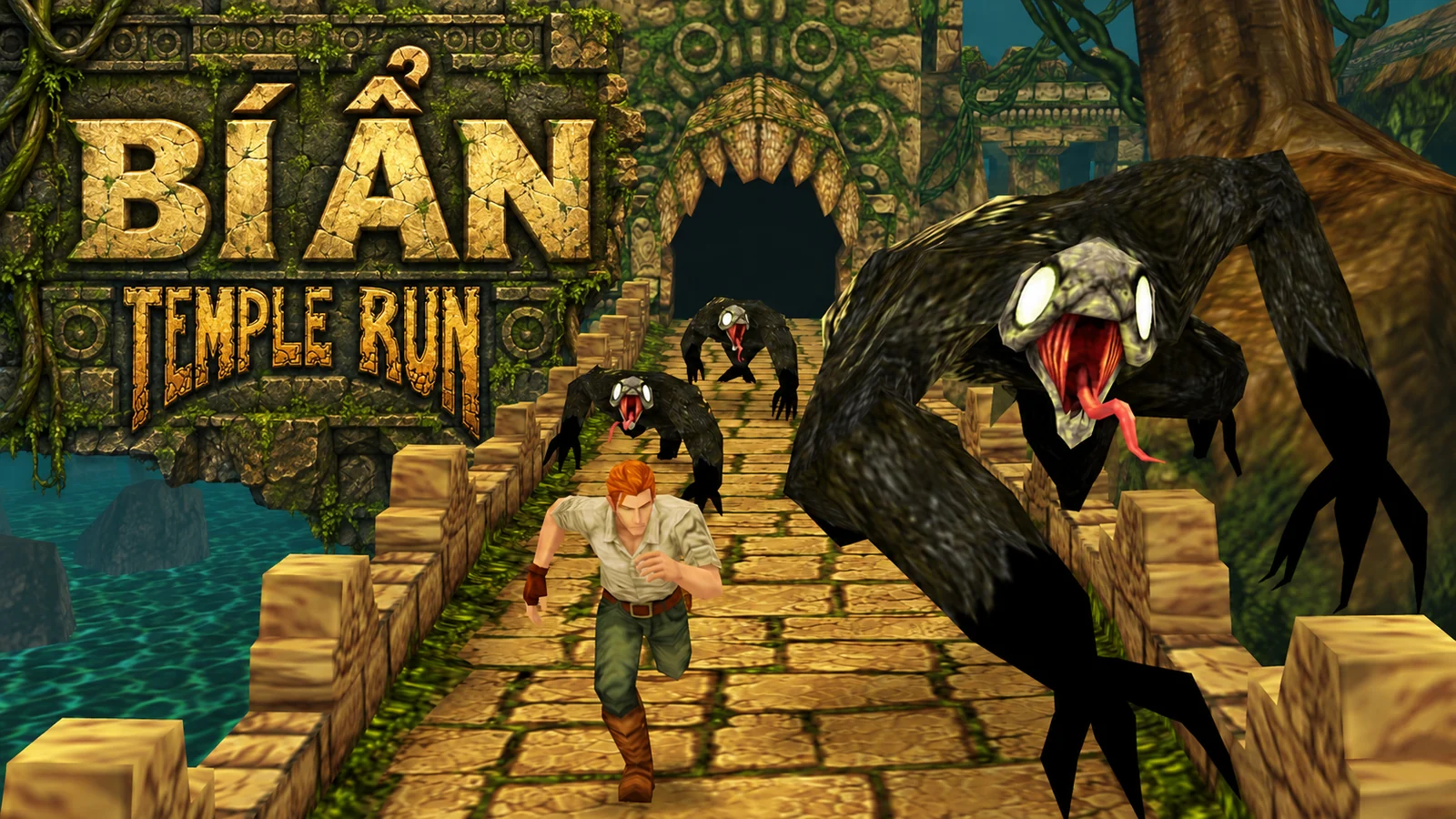
Temple Run: What if you never left the temple?
From a revenge quest with a destination, return to a run that seems to have no way out. Another perspective on the urge to keep playing.
Enter the story