
GTA III: Why does the betrayed become the betrayer?
A betrayal sends Claude to the bottom of Liberty City's criminal world. Each job takes him closer to power, while making trust harder to define.
A betrayal sends Claude to the bottom of Liberty City. The closer he gets to power, the more he resembles the people who used him. Revisit that journey in LYFP’s Vietnamese video.
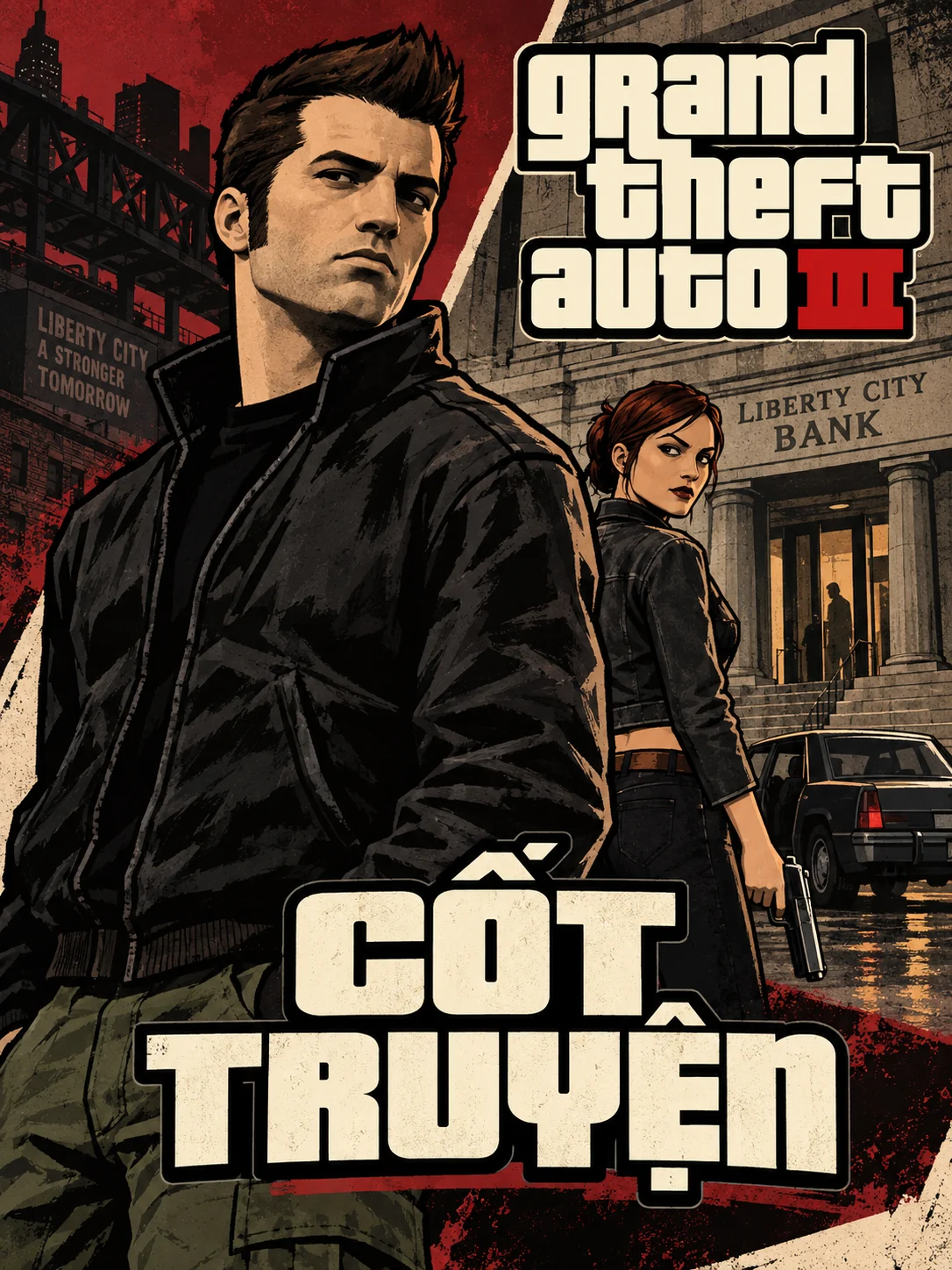
Watch within the article or open the YouTube app. The video is in Vietnamese.
Liberty City, where trust has a price. AI illustration supplied by LYFP.
As children, many of us played GTA III to steal a car, provoke the police and race through streets we eventually knew by heart. We remember the sirens, the narrow escapes and the feeling that an entire city could become our playground. Somewhere between those moments of chaos, though, the story of the man who barely speaks may have passed us by.
That man is Claude. A betrayal sends him to the bottom of Liberty City. From there, he survives by doing jobs other people would rather not carry out themselves. Every assignment brings him closer to power while leaving behind another enemy, another secret or another debt.
What makes GTA III worth revisiting is the way Claude's position changes. The man once left for dead gradually becomes someone willing to take money to betray others. To understand that shift, we need to understand the city he is trying to survive.
Liberty City: knowing the streets does not mean knowing whom to trust
GTA III was released in 2001. Rockstar Games ↗ It brought the series into a three-dimensional city. Instead of looking down at the streets as in earlier games, players were placed at road level, among traffic and junctions they could explore for themselves. It was a turning point for the series; calling it the game that invented open worlds would go beyond what needs to be claimed.
Liberty City has three areas that open as the story progresses: Portland, Staunton Island and Shoreside Vale. Docks, factories, major streets, construction sites, an airport and suburban districts give different textures to the same urban landscape. This is a fictional city that evokes industrial American cities, rather than an exact reproduction of a real location.
In Portland, power appears in tangible places: a nightclub, a garage, a restaurant, a delivery truck. On Staunton Island, people with money and influence stand further back from the street, yet can still decide who will bleed on it. The map becomes a way of telling the story. Claude moves from places where he receives jobs directly to places where those jobs are calculated.
Players learn the city by getting lost and being chased. Claude learns it by discovering who pays him, who protects him and who might change their mind. The freedom felt behind the wheel accompanies a deeply constricted story: there are plenty of escape routes, but very few safe places to stand.
One gunshot turns a partner into someone expendable
The Liberty City story begins with a bank robbery. Catalina turns her gun on Claude, leaves him behind and escapes with Miguel. His partner has become the person who wants him out of the way. Claude survives, is arrested and ends up in a prison transport.
The attack on that transport is not a rescue plan for Claude. The Cartel is targeting another prisoner; Claude and Eight Ball use the chaos to escape. This detail matters to his starting position. He does not yet have a powerful organization behind him, and nobody has welcomed him home to pursue revenge.
Eight Ball, his fellow escapee and an explosives specialist, takes Claude to Luigi Goterelli. One meeting leads to work, and work leads to connections. This is how Claude starts again in Portland. For now, he needs money and someone willing to hire him.
Claude barely speaks. That does not give the article grounds to assign him a diagnosis, an oath or an invented inner monologue. More reliable evidence lies in what he does: he accepts a job, completes it and keeps moving. At first, his silence makes it easy for players to put themselves in his place. Later, it makes judging him more uncomfortable.
The Leone family: loyalty is tested through work
Luigi runs a nightclub in Leone family territory. Claude takes small jobs and is then introduced to Joey Leone, the son of boss Salvatore. Joey's garage connects cars, money and work outside the law.
There is no grand initiation ceremony for Claude. Results move him up. A car bomb can end the life of someone from the Forelli family; a confrontation with the Triads can shift control of a neighborhood. The reward arrives after a mission, but its consequences do not disappear with the completion message.
Toni Cipriani is a capo, a leader of a crew within the Mafia. Through Toni, shops and delivery trucks become visible as sources of income that organizations fight over. Territorial disputes have practical stakes: who gets to do business, who has to pay and who has the power to silence others.
GTA III uses family imagery, hierarchy, suits and talk of honor to build a cinematic criminal world. This is how the game constructs fictional organizations, rather than an explanation of the nature of Italian people or any real community. In that world, the word "family" promises protection, but the person at the bottom still has to prove their worth through the most dangerous work.
When Salvatore wants to meet Claude, the hired hand has moved closer to the boss's table. It is an opportunity, and also the point at which his life begins to depend on the private affairs of powerful people.
Maria and the car he must not enter
Maria, Salvatore's wife, appears in a seemingly minor assignment: Claude takes her out and brings her home safely when police raid a party. The luxury surrounding the boss does not make life in his household peaceful. An outing like this places Claude inside a relationship whose consequences he cannot yet foresee.
On the business side, Salvatore is confronting the Colombian Cartel and the trade in SPANK, a fictional drug in the game. Claude discovers that Curly Bob is leaking family information to Catalina and Miguel. His employer's task suddenly intersects with his own past: Catalina is still in the city, on the other side of the transaction.
Claude and Eight Ball then destroy the ship being used to produce SPANK. The man providing cover and the man planting explosives have to work together to survive. The ship is destroyed, but the Cartel does not disappear with it. A job well done still does not guarantee Claude's safety.
Salvatore sends him to dispose of a car. In fact, it is a bomb trap. Maria warns Claude before he gets into it, then arranges to meet him at the docks.
According to Maria, she told Salvatore that she and Claude were involved. This does not establish that they really are a couple. She also says Salvatore wants to settle matters with the Cartel by eliminating Claude. Jealousy and calculations of power both appear in her explanation; reducing the whole incident to a romance would lose an important part of it.
The man who has just struck a major blow for the family is now being targeted by that same family. Claude's loyalty cannot overcome interests that have changed direction.
A new employer, but the same position
Asuka Kasen, an acquaintance of Maria and a Yakuza leader, helps them leave Portland. The boat takes Claude to Staunton Island. The city expands and so do his opportunities, but the way he earns a living remains familiar.
Asuka's protection comes with a condition. She wants Claude to prove that he has broken with the Mafia by killing Salvatore. His former employer becomes the target of his next job. Salvatore had already set a trap for Claude, so the action has a clear cause. Even so, it shows how quickly their relationship is replaced when one side no longer protects the other.
Kenji Kasen, Asuka's younger brother, runs a casino and offers his own assignments. The Yakuza bring a different language of reputation, duty and rank into the story. Those images belong to the game's construction of its criminal world. They do not make the organization a force for good or represent the character of Japanese people in real life.
Ray Machowski blurs the boundary further. A corrupt police officer, Ray hires Claude to deal with loose ends and destroy evidence. Someone who officially upholds the law purchases the same services as the gangs.
Claude changes bosses, territories and targets. His position in the chain of work has yet to change: take the dangerous part, collect the money and wait for the next assignment.
Donald Love: violence as an investment strategy
Donald Love takes the story to another level of power. Working in media and property, he can stand in a quiet room and calculate what will happen outside on the streets.
Love wants to provoke a war between the Yakuza and the Cartel. Instability can lower property prices, creating a buying opportunity. The person who profits from violence does not necessarily appear in the middle of a gunfight. For Love, a war can become part of a business calculation.
Kenji is chosen as the spark. Claude uses a Cartel car to kill him, leading the Yakuza to believe their rivals were responsible. This is the turning point that changes how we read the protagonist.
At the beginning of the game, Claude is the person Catalina betrays. Here, he accepts money to kill someone who previously gave him work, while concealing the real perpetrator. Salvatore had tried to kill Claude; the story offers no equivalent trap by Kenji to explain this action. That difference asks us to look more closely at the choice made by the character we control.
The game does not give Claude a speech in his own defense. It lets the player drive the car bearing the Cartel's identity to the location and carry out the job. The man once wounded by betrayal is now directly responsible for another betrayal.
This can be read as the harsh side of survival in Liberty City: effectiveness keeps Claude employed, but continuing to work does not mean continuing to act rightly. That is an interpretation of his actions, rather than a confession the game has written for him.
Silence in front of Asuka
Love's next assignments send Claude after a mysterious package. The real package ends up with the Cartel and takes him to a construction site where Catalina and Miguel are waiting.
Miguel wants to hand it over to find a way out alive. Catalina shoots him when he agrees to cooperate, then leaves. Once again, someone beside her is discarded when their interests no longer align.
Asuka arrives and captures Miguel because she believes the Cartel killed Kenji. Her anger rests on a false account of what happened. The person who actually carried out the killing is standing right in front of her, but says nothing.
By now, Claude's silence carries a different weight. We do not need to know his thoughts to understand the situation: Asuka is helping the man who killed her brother, and Claude continues to accept her help. Their cooperation depends on a secret that the player and a few others involved know well.
Love later disappears. The rooftop garden remains, along with an empty box and no complete explanation of where he has gone. The package's contents should not be filled in with a theory, either. That gap is part of the story's experience: the hired hand has carried the risk without being told the full nature of what he was involved in.
The dam ends the feud, without erasing what came before
Claude continues to attack the Cartel's operations. When he returns to the construction site, he finds Asuka and Miguel dead. Maria has been kidnapped; Catalina's letter demands half a million dollars in ransom. The story shows the aftermath at the scene, rather than letting us directly witness everything that happened beforehand.
Maria once warned Claude about the bomb. His decision to bring money to rescue her therefore carries weight even without the game establishing mutual romantic love. It might be a debt, an attachment or a reason to confront Catalina. These readings need to remain readings, rather than statements about the inner life of a character who does not explain himself.
Catalina takes the money and still orders Claude killed. The pursuit brings them to Cochrane Dam. Catalina is in the helicopter, while Maria is being held on the dam. Claude fights through the gunmen, fires on the helicopter and rescues Maria.
His confrontation with the person who betrayed him at the beginning has come to an end. Claude leaves the dam, but no scene confirms that he has become the boss of Liberty City. The city remains, with organizations and dealings that do not revolve solely around him.
The article leaves Maria's fate after the rescue unresolved. The story does not confirm a happy ending, nor provide grounds to turn the theory that Claude kills Maria into a fact.
Why does GTA III still feel like a city with a life of its own?
Claude takes us through the story, but Liberty City connects it all. The nightclub, garage, restaurant, casino, construction site and investor's room share a single map. Places that seem far apart are connected by work and money.
The missions also help players understand territory through experience. In an interview, Dan Houser described connecting story with mission design and player choice. That helps explain why moving through the city is also a way of learning its story. Dan Houser interview on GameSpot ↗
Radio adds a layer of life beyond the assignments. Lazlow explained that the commercials and talk programming were built as parodies of American media. Lazlow interview on WIRED ↗ Alongside Claude's experiences, that soundscape makes the city feel as though it is still talking about itself when the player is simply driving.
This is also how culture enters the experience of GTA III: through how people earn money, speak about honor, use power and treat others as a source of profit. The game builds that world through criminal imagery and satire. Viewers can recognize its perspective without treating everything on screen as a faithful portrait of society outside the game.
Vice City and San Andreas went on to develop many of the possibilities GTA III opened up. Returning to this game can still bring the pleasure of remembering a route that escaped the police. Understanding the story gives that familiar road another meaning: it once took Claude to a new employer, a new trap or a decision that cannot simply be called fair.
As children, we remembered Claude surviving every chase. Now, the question worth keeping is: what kind of person did he become in order to survive?
Do you remember GTA III for the freedom of Liberty City, or for a mission that changed how you saw Claude?
Article by LYFP Studio. The plot has been checked against LYFP's GTA III script and video. Views on the characters, power and culture are interpretations offered by this article, rather than answers imposed on the gaps the game leaves open.
Meet fellow gamers in Game Offline.
Share experiences, discover great games and meet people who share your interests.
Liberty City, from different perspectives
5 AI illustrations from LYFP’s collection. Scroll sideways to explore and tap an image to enlarge it.
More worlds to explore together
Follow LYFP to revisit memorable stories, characters and moments in games.
Ready to return to Liberty City?
This article covers Grand Theft Auto III, first released on PS2 in 2001. The purchase links below list The Definitive Edition; this does not establish the edition shown in LYFP’s video.
- Game
- Grand Theft Auto III
- First release
- 2001 · PlayStation 2
- Setting
- Liberty City
- Original developer
- DMA Design (Rockstar North)
- Publisher
- Rockstar Games
- Mode
- Single-player open-world action-adventure
References
Official sources and interviews with the creators. The retelling follows LYFP’s GTA III script; comments on trust, power and culture are editorial readings.
- 01Rockstar Games · Grand Theft Auto III ↗
Official game page.
- 02Rockstar Games · GTA III ten-year anniversary ↗
Confirms the 2001 release and the starting premise in Liberty City.
- 03GameSpot · Dan Houser interview ↗
Connecting narrative, missions and player choice.
- 04WIRED · Lazlow on radio ↗
How satirical radio and advertising add life to the city.
Article and editorial reading: LYFP Studio. AI illustrations supplied by LYFP. Grand Theft Auto III, its characters and game artwork belong to their respective owners.
GTA Vice City: You Played It Growing Up, but Do You Know the Story?
From Liberty City to Vice City: Tommy Vercetti starts over in a city full of traps.
Enter the story
GTA IV Story: Niko Bellic and the Price of the American Dream
Return to Liberty City with Niko Bellic, a different past and a different dream.
Enter the story