
God of War (2018)For his son, Kratos awakens the past
The Blades of Chaos still wait beneath the floor. To save Atreus, Kratos must take up the past that once destroyed his life. What can he teach his son to keep that tragedy from repeating?
A father hiding his past. A child who does not yet know who he is. Follow the journey that brings Kratos back to the Blades to save his son. Video narrated in Vietnamese.
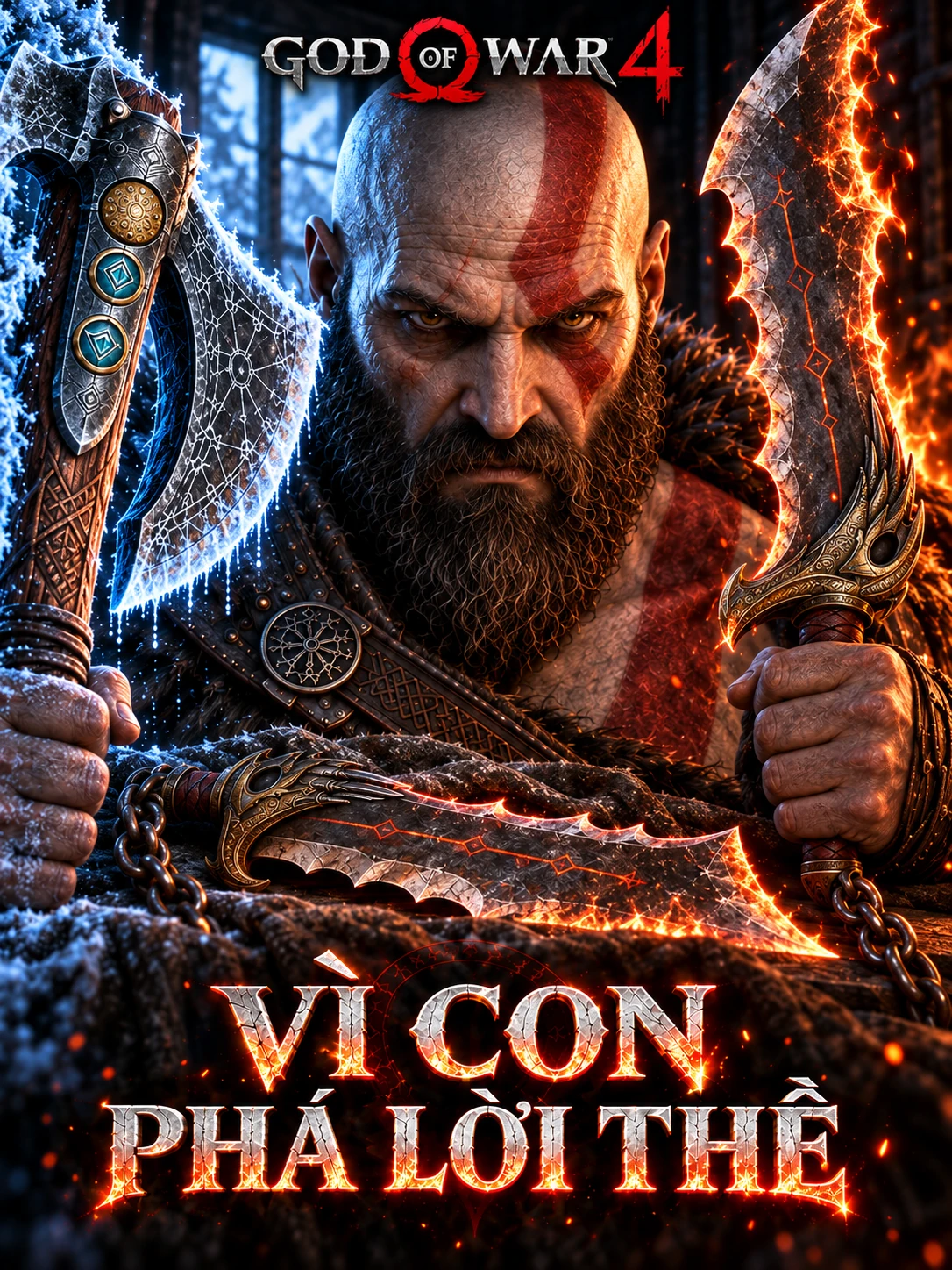
Watch within the article or open the YouTube app. The video is in Vietnamese.
On one side, the life he is trying to protect. On the other, the past he must take up again. AI illustration · LYFP Studio.
Beneath the floor of a cabin in Midgard, Kratos has put away part of his life. He can cover the blades, wrap the scars and let his son grow up without knowing who his father used to be. Then Atreus collapses. To keep the boy alive, the father must go home and uncover the very thing he wanted to bury.
The return of the Blades of Chaos gathers the whole journey of God of War (2018) into those hands: hands that once brought catastrophe, now frightened of losing a son. The past still has its old shape. What changes the story is the person Kratos wants to protect when he picks it up.
From Faye’s last wish to the land of the giants, join LYFP in retracing that journey through battles, silences and a god’s hardest lesson: teaching his child to have strength without being ruled by it.
A bag of ashes, two people learning to stand together
The revenge in Greece is over. In the woods of Midgard, Kratos has a new family, but the game introduces us just as they lose the person who held them closest together. Faye has died, leaving a wish for her ashes to be scattered from the highest peak in all the realms.
Kratos knows how to fell a tree, build a pyre and prepare for danger. Beside a child who has just lost his mother, he is uncertain. His severity can make Atreus perform an action correctly; it cannot yet help the boy understand his father’s grief. The journey begins with that distance, before the distance to the mountain.
Then a stranger appears at the door. Baldur takes blows strong enough to tear the ground apart and keeps coming. The home that hid Kratos’s past is no longer safe. With the protective barrier broken after the felling of Faye’s marked trees, father and son must venture outside, carrying her ashes and much they have not found a way to say.
Strength alone cannot open the Norse world
Here, a line of runes can matter as much as a swing of the axe. Atreus reads signs his father cannot understand. The dwarven brothers Brok and Sindri help their weapons keep pace with the journey. Mimir carries memories of gods, debts and sealed doors. Kratos protects the group, but finding the way requires everyone’s knowledge.
When Jörmungandr, the World Serpent, rises in the Lake of Nine, the water level changes and paths emerge. Myth has physical weight: one creature’s movement is enough to reshape the map. Returning to the lake brings both familiarity and discovery, as though the land still holds layers of memory it has not revealed.
Yggdrasil, the World Tree, and realm travel through the Bifröst place the journey in a space larger than the mountains in sight. At Midgard’s highest peak, Mimir tells them that Faye’s destination lies in Jötunheim. The destination has changed; her wish has not.
God of War builds its own story from Norse mythology. Runes, dwarves, realms and prophecy give the world its workings, while the game arranges relationships and fates along its own narrative. Reading the journey as a mythic tragedy is more rewarding than treating it as a literal retelling of ancient tales.
The father’s axe, the son’s arrows
The Leviathan Axe can be thrown and recalled to Kratos’s hand. Players consider the attack’s direction alongside the axe’s position and the moment to call it back. In puzzles, its ability to affect mechanisms gives the weapon a role after combat falls silent. Strength needs observation.
Atreus is part of those decisions too. His supporting arrows can create an opening for Kratos to close in, while his skills and equipment develop along the journey. Improving the bow means investing in a teammate. Santa Monica’s official guidance also emphasizes upgrading Atreus alongside Kratos.
Santa Monica Studio: gameplay guidance ↗In LYFP’s reading, this cooperation gives their bond a tangible form: we grow used to calling on the child for help, then realize that even this powerful warrior needs someone beside him. Across many battles, trust takes shape in our actions before the two are close enough to put it into words.
While the father hears the dead, the son waits alone
The Black Breath blocks the mountain path, sending father and son to Alfheim for its light. Amid a beautiful realm at war, Kratos hears Faye inside the light and steps in. For him, it is a brief closeness to his lost wife. For Atreus outside, it is a stretch of time spent fighting without his father.
When the boy pulls Kratos out, he is angry and exhausted. The same event has left them with different experiences. The scene gives Atreus’s accusations a clear cause: he needs to know that when he calls, his father will still be there.
That makes Kratos’s later repair of his son’s strap with a piece of mistletoe arrow quietly significant. Tender words do not come easily to him, but he still bends down to do something small for the child. The detail returns near the journey’s end, linking an ordinary act of care to a turning point for the gods.
What he hid beneath the floor
After their encounters with Magni and Modi, danger no longer comes only from someone wielding a weapon. As Modi pins Kratos down with lightning, Atreus rushes forward in anger and collapses. Freya identifies the conflict destroying him: he is a god who has grown up believing he is mortal.
Kratos concealed their nature so his son could live beyond the gods’ shadow. Now that secret has helped push Atreus to the brink. To save him, Kratos must bring back the heart of the bridge keeper in Helheim, where his frost-powered axe cannot carry him through the trials ahead.
He returns home, opens the wrapping and winds the Blades of Chaos’ chains around his arms again. Each coil returns to a scarred wrist, bringing back the life he tried to put away. Atreus still needs saving. Between the fear of facing himself and the fear of losing his son, Kratos chooses to carry the old fire into the realm of the dead.
The Blades’ return also changes combat. Fire and sweeping chains expand his options alongside the axe. For players who knew Kratos in earlier games, reclaiming a familiar weapon comes with a new purpose: this time, he uses it to bring a life back.
Athena’s apparition appears, a reminder that the past can still call him by name. Kratos keeps going. The scene neither erases his guilt nor makes him an entirely different person; it shows him choosing what to do with the hands that caused it.
Telling the truth is not the same as teaching understanding
Atreus is saved. Kratos also reveals what he has hidden: they are both gods. But the child receives that identity as a reason to place himself above others. When Modi appears in a wretched state, Atreus kills him despite his father’s order to stop.
The scene puts Kratos’s fear before him. His son does not need to know the whole story of Olympus to begin following his father’s familiar logic: strength grants the right to decide a weaker person’s fate. Learning his origins has shown Atreus what he can do; he still needs to learn why some things must be left undone.
His arrogance continues to expose him to Baldur. After the incident at the Jötunheim gate and their escape from Helheim, father and son must learn to work together again. Trust can be hurt, then rebuilt through what comes next. Kratos needs to let his son correct his mistakes while learning to guide him with more than commands.
A mother who cannot let her child hurt
Freya and Baldur’s tragedy offers another form of protection beside Kratos and Atreus’s relationship. To avert a prophecy of losing her son, Freya makes Baldur invulnerable. The cost is his ability to feel pain, warmth or life’s pleasures. He begs her to remove the spell; she keeps it in place.
In LYFP’s reading, fear of losing someone has led both Freya and Kratos to decide what their children may know or experience. Their protective motives are real. So is the damage their choices cause. Baldur shows how far a relationship can deteriorate when the protected person’s voice is no longer heard.
The mistletoe on Atreus’s strap pierces Baldur’s hand, breaking the protective spell. He feels his wound and the cold snow. Something Kratos once used in a small repair for his son becomes the thing that neither strength nor anger could replace.
But sensation’s return cannot erase years of resentment. Baldur can feel pain again and still chooses to make his mother pay. The story now reaches beyond a curse: magic can break in an instant, but a ruined relationship cannot heal as quickly.
Victory does not give everything back
Father and son defeat Baldur. At Freya’s plea, Kratos spares him. That pause shows that the man once driven by revenge can choose differently. But Baldur turns to strangle his mother, and she accepts death if it will ease his anger.
Kratos intervenes and kills Baldur to save Freya. He stops a child from killing a parent in front of Atreus, while taking the only son of the woman who saved his own. Freya lives and swears revenge. An action with a reason still leaves someone holding a familiar body on the ice.
Santa Monica has explained that this climax needed to show how well father and son had learned to fight together, while confronting them with an outcome that carries a cost. The cooperation in battle and the tragedy after victory answer the same question: how has the journey changed them?
Santa Monica on the final Baldur encounter ↗Afterwards, Kratos tells Atreus about the people he killed, including those who did not deserve to die and his own father. He no longer merely demands obedience. He gives his son the truth needed to understand why his father wants him to know when to stop.
On the mountain, another name awaits
In Jötunheim, the murals reveal that Faye was a giant and that her family’s journey was known in advance. The handprints on the trees and her final wish take on new meaning. The woman absent throughout their travels is still present in the direction father and son have chosen to follow.
Kratos sees a mural suggesting something troubling ahead. The 2018 game’s ending does not resolve every part of that foreshadowing. What is certain in this moment is that they scatter Faye’s ashes together: they have brought her home and learned how to stand beside each other.
Atreus also has the name his mother gave him: Loki. Back in Midgard, father and son enter the winter that signals Ragnarök; Thor appears at their door in Atreus’s dream. This is a threshold to the next story, not a battle with Thor occurring in this game’s main narrative.
What stays with LYFP is the sight of Kratos’s wrists as he removes their wrappings. He no longer needs his son to see a father without a past. The scars remain, along with the possibility of living differently. Kratos cannot promise that the world will stop hurting his child. He has begun to give him something more necessary for facing it: the truth about his father and a reason not to repeat what that father once did.
Meet fellow gamers in Game Offline.
Share experiences, discover great games and meet people who share your interests.
The past beneath the floor
Four views of a father between fire and ice. Swipe to browse and tap to enlarge. These are AI illustrations, not gameplay screenshots or evidence of the story.
More worlds to explore together
Follow LYFP to revisit memorable stories, characters and moments in games.
Ready to join Kratos and Atreus?
Choose God of War (2018). Use the official purchase and download pages below.
- Official title
- God of War (2018); often referred to as God of War 4
- Developer
- Santa Monica Studio
- PlayStation publisher
- Sony Interactive Entertainment
- PC publisher listed by Epic
- PlayStation Publishing LLC
- Genre
- Single-player, third-person action-adventure
- PS4 release
- 20 April 2018
- PC release
- 14 January 2022
- Platforms
- PS4, Windows PC; the PS4 version is playable on PS5 through backward compatibility
- Setting
- A world inspired by Norse mythology
Sources and material
Adapted from LYFP’s approved narration. The official sources below support the story events, gameplay and edition details; personal interpretations are LYFP’s reading.
- O1PlayStation · God of War ↗
Official title, PS4 release, platforms, setting and general combat features.
- O2Santa Monica · God of War (2018) story recap ↗
Reference for Faye’s wish, Atreus’s illness, the Blades, Baldur, Freya and Jötunheim. Used for the 2018 story only.
- O3Santa Monica · Gameplay guidance and the PC launch ↗
The 14 January 2022 PC release and Atreus’s support role and upgrades.
- O4Santa Monica · Designing the final Baldur encounter ↗
The intent to show father and son’s coordination and a victory with consequences.
- O5Epic Games Store · God of War ↗
Developer and the listed PC publishing entity.
Writing and interpretation: LYFP Studio, adapted from LYFP’s approved narration. AI illustrations: LYFP Studio. God of War, its characters and its world belong to their respective owners, including Sony and Santa Monica Studio.
God of War III: After defeating Zeus, what does Kratos have left?
Revisit the revenge in Greece to understand the weight of the past Kratos carries into the Norse world.
Enter the story
Temple Run: What if you never left the temple?
Another reading of a familiar game. This one explores a theory, rather than retelling the established story.
Enter the story